Why Choose PrestaShop Over Shopify in 2026
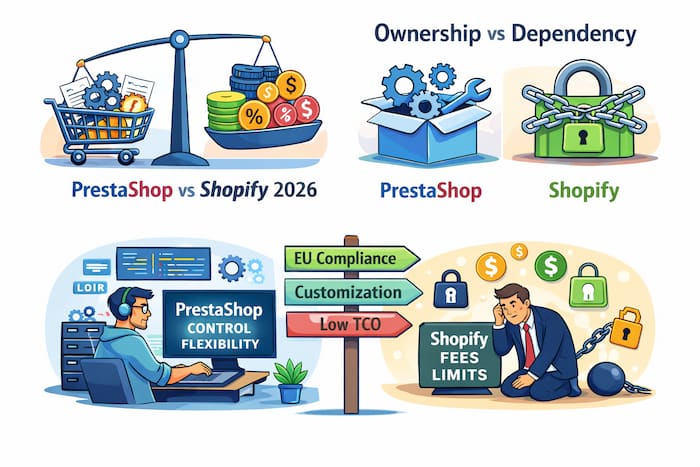
Between 2019 and 2023, Shopify became the global benchmark for rapid online store deployment However, the 2024–2026 market cycle reshaped priorities: businesses increasingly shift from “quick launch SaaS” toward cost-efficient, customizable and compliance-ready e-commerce platforms. In this landscape, PrestaShop has regained momentum — especially in Europe — thanks to greater ownership, flexibility, and dramatically lower Total Cost of Ownership (TCO).
Below is a detailed breakdown of why in 2026 PrestaShop is frequently a better strategic choice than Shopify.
1. Total Cost of Ownership (TCO) in 2026: Shopify Taxes Growth, PrestaShop Scales Freely
Shopify is cheap only at the beginning. The moment a merchant scales, Shopify starts adding multipliers:
- Transaction fees (Shopify vs. Shopify Payments vs. third parties)
- Checkout app fees
- Subscription apps for basic features
- Upgrade to Shopify Plus for enterprise capabilities
- Revenue % fees in certain regions
- Higher cost for international domains & currencies
For mid-size merchants activating marketing, loyalty, B2B, multi-language and multi-market features — Shopify’s monthly recurring fees often exceed €1,000–€6,000/month + commissions.
PrestaShop, being open-source, offers a flatter curve:
- No obligatory commission on turnover
- One-time or annual plugin costs instead of subscriptions
- Server cost predictable and cheap (VPS/cloud)
- Unlimited developers & freedom to build internally
This cost asymmetry compounds at scale.
2. Technical Ownership and Customization: PrestaShop Wins for Engineering and Product Teams
Developers increasingly prefer platforms that:
1. expose code
2. allow structural changes
3. allow integration without vendor lock-in
4. support CI/CD and custom infrastructure
Shopify limits customization to its theme layer + app layer. Critical parts (checkout, payments, routing, data layer, SEO) remain locked behind the SaaS wall.
PrestaShop enables:
- Custom checkout
- Server-side tagging & tracking
- Internal plugins
- Headless implementations
- Custom microservices
- Performance tuning (cache, CDN, queues)
In 2026 this matters more because storefronts have become engineering-driven marketing assets, not static catalogues.
3. Compliance Era 2026: GDPR, EAA, Cookie Consent, Server-Side Tracking
Europe introduced strict compliance requirements 2024–2026:
- GDPR enforcement tightened
- Digital Services Act (DSA)
- Digital Markets Act (DMA)
- EAA (Accessibility)
- Consent Mode V2
- Stricter cookie banners
- Server-side event tracking (GA4, Meta, Ads)
- Data residency expectations
Shopify compliance is generic and US-centric; workarounds often require paid apps or partial hacks.
PrestaShop aligns better with EU regulatory reality:
- Full data ownership
- Server location control (EU-based hosting)
- Accessibility modules
- Cookie consent implementations without external vendors
- Server-side tracking on merchant infrastructure
- B2B VAT rules, invoices, and EU-local requirements
For EU-based merchants this is a decisive factor.
4. Multi-Language & Multi-Market Operations
Shopify still treats multi-language/store domains as bolt-ons. Shopify Plus improves this, but at a high entry price.
PrestaShop offers:
- Native multi-language
- Native multi-currency
- Native tax/VAT localization
- Domain per market setups
- Customizable product attributes per locale
This is why PrestaShop remains strong in:
🇫🇷 France
🇪🇸 Spain
🇮🇹 Italy
🇵🇱 Poland
🇺🇦 Ukraine
🇩🇪 Germany (growing)
European SMEs often prefer one instance for multi-market operations.
5. Merchant Control vs Vendor Risk
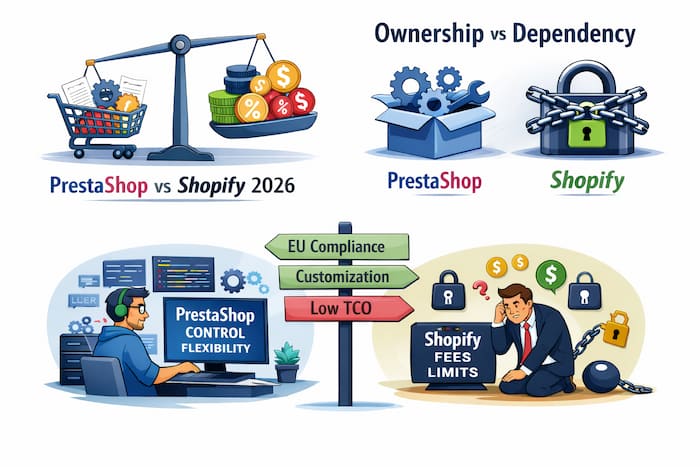
With Shopify you rent the store, not own it:
- Shopify can ban industries
- Can suspend stores
- Can remove payment methods
- Can change pricing or feature gating
- Can introduce new compliance rules overnight
In 2024–2025 Shopify restricted several sectors (supplements, CBD, certain B2B parts, digital goods, streaming).
PrestaShop is vendor-neutral:
- No platform lock-in
- Store runs independently of corporate policy shifts
For long-horizon merchants, this risk matters.
6. Developer Ecosystem & Marketplace Economics
Shopify App Store became extremely expensive and subscription-heavy:
- €10–300/month per app
- Often multiple apps for one feature
- Vendors introduce upsells on usage-based billing
PrestaShop Addons Marketplace is shifting in the opposite direction:
- One-time payments or annual renewals
- Lower app stacking
- Many functions built by agencies directly for merchants
- Possibility to fork modules or develop in-house
This improves TCO and reduces operational fragility.
7. SEO & Performance: Real Technical Advantage
SEO professionals increasingly criticize Shopify’s:
- URL structures
- Limitations in sitemaps
- Limited control over performance optimization
- Poor core vitals (especially LCP/CLS)
- Script bloat from apps
- Clean URL management
- Assets optimization
- Server-level cache and CDN control
- Custom server-side redirects
- No forced JS bundles
- Freedom to use Cloudflare, AWS, Bunny, etc.
With Core Web Vitals playing a role in conversions and ads, performance is a revenue lever, not a technical detail.
8. B2B, Wholesale & Hybrid Commerce
Shopify remains B2C-centric; B2B is gated into Shopify Plus.
PrestaShop shines where stores need:
- Quotes
- VAT handling
- Purchase orders
- Customer groups
- Custom pricing
- Volume discounts
- Payment terms
European wholesalers especially gravitate toward PrestaShop for these reasons.
9. Community & Longevity
PrestaShop is open-source at its core. Unlike SaaS platforms, it does not rely on infinite fundraising or fantasy valuations. Community and agencies sustain it.
SaaS platforms may collapse, pivot, or shut down features when capital squeezes (we saw that across 2020–2025).
Open-source platforms tend to outlive SaaS cycles.
When Shopify Still Makes Sense in 2026
Objectively, Shopify is still strong when:
1. single-product DTC brands
2. influencer commerce
3. ultra-fast launch
4. disposable stores
5. US-first operations
6. subscription billing
7. heavy reliance on Shopify Payments
But beyond SMB DTC — Shopify hits ceilings.
Conclusion: Shopify Sells Convenience; PrestaShop Enables Ownership
2026 merchants care less about launch speed and more about:
- Margin
- Compliance
- Data control
- Tracking control
- Custom business logic
- Scalability without tax
- European regulatory alignment
PrestaShop offers:
Ownership, extensibility, and sustainability.
Shopify offers:
Convenience and dependency.
For entrepreneurs, agencies, and engineering-driven e-commerce teams — 2026 is the year where ownership wins.
A) Financial & Business Added Angles
1. Payment Freedom & Acquiring Options
Shopify strongly pressures merchants into Shopify Payments; many industries/countries have constraints or worse FX rates. PrestaShop allows:
- local acquirers
- crypto gateways
- B2B invoicing
- offline payments
- bank integrations (SEPA, SWIFT)
- PSD2 compliance
- reduced FX fees
Europe especially values local acquirers (Adyen, Mollie, PayU, Stripe EU, etc.).
2. No Revenue-Based Penalization
Useful to mention that Shopify’s revenue-take model effectively taxes success, whereas PrestaShop TCO is closer to linear.
3. Lifetime Value & Depreciation
For large merchants, open-source stores can be capitalized and depreciated as assets, while Shopify subscriptions cannot — a real CFO angle.
B) Technical & Architecture Additions
4. Headless / Composable Commerce Trend
2024–2026 the market shifted to:
- headless storefronts
- microservices
- decoupled backends
- composable checkout
- PIM/OMS integrations
Shopify Headless = possible but severely limited/gated + expensive.
Prestashop = easier to use as backend + open DB + API + direct infrastructure access.
5. DevOps & Infrastructure
Technical buyers love this angle:
- CI/CD possible
- staging environments standard
- can run on Kubernetes, Docker, VPS, cloud
- choice of CDN (Cloudflare, Bunny, AWS, Akamai)
- logs, observability, Sentry, SIEM — all possible
This reinforces the “engineer-first commerce” framing.
6. Data Access & Analytics
Shopify walls off critical data for:
- attribution modeling
- server-side tracking
- LTV/CAC modeling
- custom BI dashboards
Prestashop enables:
- raw DB
- ETL pipelines
- custom BI (PowerBI, Looker, Metabase)
- server-side events
- advanced A/B testing
In 2026 data is a weapon → merchants want freedom.
C) Legal, Regulatory & Geopolitical Additions
7. Sovereign Hosting & Jurisdiction
Very relevant after 2022–2026 geopolitics:
- EU merchants prefer EU jurisdiction
- data residency matters (DE, PL, FR ministries push it)
- sanctions & compliance risks matter
- government & defense procurement forbid foreign SaaS
Open-source aligns with these trends.
8. Accessibility (EAA) Enforcement
EAA comes into force 2025/2026 → many Shopify themes do NOT comply.
PrestaShop allows structural accessibility modifications.
D) Operational & Marketing Additions
9. Content Marketing & CMS Layer
Shopify’s CMS is weak vs:
- multi-language
- multi-author
- landing pages
- headless CMS (Storyblok, Strapi, etc.)
Prestashop can integrate CMS or embed headless CMS freely.
10. Marketplace Integrations
Amazon/OTTO/Bol/Allegro integrations are easier in open-source for:
- custom ERP feeds
- pricing sync
- warehouse sync
Plus, Shopify marketplaces = subscription-based apps again.
11. B2B2C, D2C + B2B Hybrid
Hybrid commerce (often ignored) is growing in Europe:
Example use cases:
- brand → retailer → end-user
- factory → distributors → stores
- spare parts & service catalogs
Shopify is weak here without Shopify Plus.
E) Strategic & Ecosystem Perspectives
12. Ecosystem Agnosticism
Shopify tries to control ecosystem layers:
- payments
- marketplace apps
- logistics (Shopify Fulfillment)
- checkouts
- analytics
Prestashop = open ecosystem → more business optionality.
13. Anti-Lock-In Trend
2026 trend in SaaS procurement = avoid lock-in.
Investors, CTOs, procurement departments push for portability.
14. M&A / Exit Considerations
If a store is an asset in acquisition:
- open-source codebase increases valuation
- Shopify subscription limits portability & due diligence
Investment bankers actually care about this.
F) Future-Proofing / 2027+ Projection
15. AI / Commerce Automation
Open-source is better for:
- proprietary AI models
- private data sets
- automated pricing
- custom recommendation engines
- server-side personalization
Shopify AI = vendor-managed black-box for generalized use cases.
G) Missing Contrarian Angles (Useful for Credibility)
You could also add small “cases where Shopify wins” beyond DTC — for credibility:
- single SKU brands
- micro influencers
- POD (print-on-demand)
- dropshipping
- US-first merchants
- stores under 1–2 years lifetime horizon
This shows the paper isn’t ideological.
Overall Conclusions
The 2026 e-commerce landscape rewards ownership, flexibility, compliance and intelligent cost structure rather than pure launch speed. Shopify remains the best embodiment of convenience-as-a-service, but convenience now scales poorly for merchants who grow beyond the early DTC phase, expand internationally, or require serious operational control.
PrestaShop fits the new reality better: it offers a platform that merchants can shape according to market, legal, engineering and financial constraints rather than adapting the business to the limitations of a SaaS provider. From TCO and acquiring options to data access, tracking, accessibility and DevOps, PrestaShop behaves not as a rental storefront but as a long-term commerce asset.
In practical terms:
- SMBs and SME/enterprise firms
gain lower lifetime costs - European merchants
gain regulatory alignment and jurisdiction control - B2B and hybrid commerce
gain functionality without enterprise gating - Developers and product teams
gain architectural flexibility - Finance teams
gain predictable costs instead of revenue-dependent taxation - Marketing teams
gain better tracking, BI and personalization integrations
Choosing between Shopify and PrestaShop in 2026 is therefore less about features and more about strategy: whether a merchant wants to optimize for speed and dependency, or for control and ownership.
In this cycle, ownership has the stronger long-term returns.
Translate all in one using ChatGPT SEO translation – PrestaShop module